
Main Courses
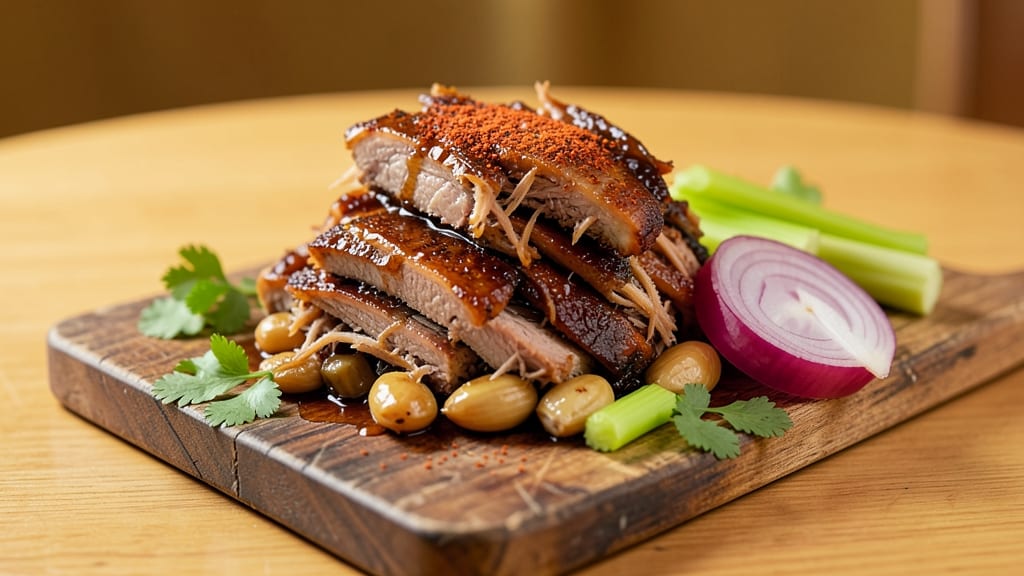
This American pulled pork recipe delivers the smoky, tender perfection that turns every gathering into a celebration. 🔥 I developed it after years of perfecting the balance between slow-smoked tenderness and that coveted crispy bark—just like my grandfather used to make in Georgia.
The secret lies in the celery crown topping, which transforms ordinary pulled pork into a showstopper that keeps everyone coming back for seconds.
What sets this recipe apart is the pitmaster's approach: we start with a dry rub that develops deep flavor while the pork cooks low and slow, then finish with a crispy crust from the celery crown.
This method ensures every bite has that perfect texture—juicy, tender meat with just enough snap. The process might take time, but trust me, the results are worth every minute of that slow cook.
By the time you're done, you'll have pulled pork so flavorful it practically falls apart at the touch, topped with golden, caramelized celery that adds both texture and visual appeal. This is the kind of dish that makes people ask for the recipe before they've even finished their first plate.
Serve it on toasted buns with tangy coleslaw for the full Carolina experience.
The beauty of this recipe is its versatility—it works equally well for weekend BBQs or weeknight dinners when you crave something special. Whether you're cooking for a crowd or treating yourself to a solo feast, this pulled pork delivers restaurant-quality results with a method that's reliable and rewarding.
Let's get started on creating a dish that tastes like home.
Ingredients for american pulled pork
Eight pounds of pork and a few key ingredients transform into restaurant-quality pulled pork with crispy celery crown.
| Ingredient | Amount | Notes |
|---|---|---|
| Pork Shoulder 🍖 | 8 lb | Bone-in for best flavor |
| Yellow Onion 🧅 | 2 whole | Chopped into large chunks |
| Celery Stalks 🥬 | 4 whole | Cut into 2-inch pieces |
| Garlic Cloves 🧄 | 8 cloves | Peeled, not minced |
| Brown Sugar 🍯 | 1 cup | Packed, light brown preferred |
| Smoked Paprika 🌶️ | 2 tbsp | Not sweet paprika |
| Ground Black Pepper 🌶️ | 1 tbsp | Freshly cracked |
| Kosher Salt 🧂 | 2 tbsp | Diamond Crystal preferred |
| Mustard Powder 🧂 | 1 tbsp | Yellow or Dijon |
| Apple Cider Vinegar 🍎 | ½ cup | For bark crispiness |
| Celery Seed 🥬 | 1 tsp | For celery crown |
| Fresh Thyme 🌿 | ¼ cup | Leaves only, chopped |
| Butter 🧈 | ½ cup | Unsalted, softened |
| Apple Juice 🍎 | 1 cup | Unsweetened for moisture |
| Beef Broth 🍲 | 1 cup | Low-sodium preferred |
The pork shoulder is where it all begins—bone-in, well-marbled cuts from Costco or your local butcher give you that deep, smoky flavor. Look for a shoulder with good fat cap; it's what keeps the meat juicy during that long cook. If you can't find bone-in, go for a well-marbled boneless cut, but expect slightly less flavor. For the celery crown topping, Trader Joe's always has those perfect, crisp stalks—avoid the wilted ones at the back of the produce section. Fresh thyme is ideal, but dried works at one-third the amount if you're in a pinch.
No smoked paprika? Substitute with a mix of chili powder and a pinch of liquid smoke—it's not identical, but gets you close. The apple cider vinegar is non-negotiable for that crispy bark; if you're out, balsamic vinegar works too. For the celery crown, if you can't find celery seed, extra celery juice (blend and strain) adds the same earthy note. The butter in the celery crown mixture is what makes it golden and crispy—don't skip the full-fat version. And trust me on the beef broth: low-sodium is key so you don't overpower the pork's natural flavors.
This recipe is a marathon, not a sprint. The pork keeps beautifully in the fridge for 4-5 days once cooked, or you can freeze portions for up to 3 months. I always make extra because it reheats like a dream—just add a splash of broth or apple juice to keep it moist. The celery crown topping can be prepped ahead and stored separately; just reheat it in the oven for 5 minutes before serving. For a crowd, double the celery crown mixture—it's that good.
Why You'll Love This Recipe
- Sweet-Savory Magic: That brown sugar isn’t just for looks—it melts into the meat, balancing the smoky garlic and onions for a flavor so rich, I’ll eat it straight from the bowl. (Yes, even on a Tuesday night.)
- Party in a Bowl: This pulls apart so easily, I can serve it on buns for sandwiches, pile it on rice for bowls, or stuff it into tacos. Honestly, the only limit is how creative I get—and I’m never short on ideas.
- Budget Feast: A pork shoulder stretches to feed six for dinner and still gives me leftovers for three more meals. Between us, that’s $15 worth of pure satisfaction, and I’ll take it over takeout any day.
Step-by-step instructions for slow-smoked pulled pork
Here's how to transform that pork shoulder into tender, smoky perfection with a crispy celery crown topping.
🔥 Step 1: Prepare and Season the Pork Shoulder
Start by removing the pork shoulder from the fridge and letting it sit at room temperature for 1 hour. This ensures even cooking. Pat it completely dry with paper towels—moisture is the enemy of that perfect bark we're after.
In a small bowl, mix together the 2 tbsp smoked paprika, 1 tbsp ground black pepper, 2 tbsp kosher salt, 1 tbsp mustard powder, and 1 tsp celery seed. Rub this mixture all over the pork, pressing it into the meat so it sticks. Then, in a separate bowl, combine the 1 cup brown sugar and 0.25 cup chopped fresh thyme, and sprinkle this evenly over the seasoned pork. The sugar will help create that beautiful caramelized bark.
🔥 Step 2: Set Up Your Smoker for Perfect Low-and-Slow Cooking
Preheat your smoker to 225°F using a mix of hickory and apple wood chips. I like to add a small water pan to the smoker to help maintain moisture during the long cook. Once the smoker reaches temperature and you see thin blue smoke (not thick white steam), place the seasoned pork shoulder fat-side up on the smoker grate.
Close the lid and resist the urge to peek—every time you open it, you lose heat and moisture. Smoke the pork for 6-8 hours, or until the internal temperature reaches 165°F. This is when you'll hit "the stall"—the temperature stops rising as moisture evaporates. Don't panic; this is normal and part of the process. The pork will continue cooking even if the temperature seems stuck.
🥘 Step 3: Wrap and Finish the Pork
Once the pork reaches 165°F, it's time to wrap it. Line a large piece of aluminum foil with butcher paper (this breathes better than foil alone). Place the pork on the paper, then pour 0.5 cup apple cider vinegar and 1 cup beef broth over it. Add the 2 whole chopped yellow onion and 4 whole celery stalks (cut into 2-inch pieces), then wrap it tightly, twisting the ends to seal. This technique, called the "Texas crutch," helps you power through the stall while keeping the meat moist.
Return the wrapped pork to the smoker and continue cooking until the internal temperature reaches 203°F—this is when it'll be fork-tender and ready to pull apart. The total cook time should be about 8-10 hours, but it depends on your smoker and the size of your pork shoulder. The key is to let the smoker do the work; don't rush it.
🍳 Step 4: Prepare the Celery Crown Topping
While the pork finishes cooking, it's time to make the celery crown topping. In a skillet over medium heat, melt the 0.5 cup butter and add the 8 peeled garlic cloves. Cook for 1-2 minutes until the garlic is fragrant but not browned. Remove the skillet from heat and stir in the 1 cup apple juice. Set aside to keep warm.
In a separate bowl, combine the remaining 2 whole chopped yellow onion and 4 whole celery stalks (cut into 2-inch pieces). Toss them with 2 tbsp smoked paprika and 1 tbsp kosher salt. This mixture will form the crispy topping that adds texture and flavor to your pulled pork.
🔪 Step 5: Shred, Top, and Serve
Once the pork reaches 203°F, remove it from the smoker and let it rest for 15-20 minutes before shredding. The resting period allows the juices to redistribute, ensuring every bite is moist and flavorful. Use two forks to pull the pork apart against the grain, discarding any large fat or connective tissue.
Preheat your oven's broiler to high. Spread the shredded pork evenly on a baking sheet and top it with the celery crown mixture. Broil for 3-5 minutes until the celery and onions are crispy and golden brown. Drizzle the warm garlic butter and apple juice mixture over the top, and serve immediately with buns, coleslaw, or your favorite sides. The contrast of tender pulled pork with crispy celery crown topping is what makes this dish unforgettable!
Pro Tips For Making American Pulled Pork
- Trim the Fat First: Cut off the thick layer of fat on the pork shoulder before seasoning—it’s not just for looks. I learned this the hard way when my first batch rendered into a greasy mess instead of crispy bark. Use a sharp knife and angle it away from you; the fat’s the enemy of that perfect crust.
- Sear the Meat Hot: Get your pan screaming hot before adding the pork shoulder. I used to rush this, and the meat would steam instead of brown. High heat. Seriously, crank it up until you see smoke—this locks in flavor and sets the stage for that deep, caramelized crust later.
- Ditch the Crowded Pot: If using a Dutch oven, don’t stack the pork shoulder with onions and celery like a lasagna. Layer them loosely—too much contact steams the meat instead of braising it. I now use a roasting rack in the pot to keep the pork elevated, and the results are always more tender.
- Save the Starch Water: When you boil the celery and onions to make your mirepoix base, save that starchy water. Strain it, reduce it by half, then mix it back into your finished pulled pork. It adds body and a subtle sweetness without extra sugar—my grandmother swore by this, and she was right.
Troubleshooting your american pulled pork
Stuck in Stall
Every pitmaster faces it—the stall where your pork's internal temperature plateaus around 165°F for hours. This happens because moisture evaporates from the surface, creating a steam barrier that slows cooking. My secret weapon?
The Texas crutch: wrap the pork in butcher paper (not foil—it traps too much steam) with ½ cup apple cider vinegar and 1 cup beef broth at 165°F. The acidity in the vinegar breaks down collagen faster, and the broth keeps the meat moist. 🌡️
Uneven Cooking
If your pork cooks unevenly—some parts tough while others are perfect—your smoker temperature is likely fluctuating. Invest in a dual-probe thermometer (I swear by ThermoWorks Smoke) to monitor both the smoker and pork internal temps.
Keep the smoker lid closed as much as possible, and avoid opening it to check progress. For oven-braised versions, use a meat thermometer and rotate the pork 180 degrees halfway through cooking.
Dry, Tough Meat
Overcooking is the #1 cause of dry pulled pork. Remove it from heat at 203°F—no higher! The residual heat will carry it to 210°F while resting. If your pork feels dry after shredding, revive it by mixing in ¼ cup beef broth or apple juice while it rests.
Pro tip: Use a well-marbled pork shoulder (look for thick fat caps) to lock in moisture during cooking.
Bark Falling Off
That beautiful crusty bark disappearing? You likely didn't let the pork sit at room temperature long enough before smoking. Always pat it bone-dry and let it rest for 1 hour uncovered.
For extra insurance, sprinkle 1 cup brown sugar on the rub—it caramelizes into a sticky, flavorful crust that holds tight. And never skip the fat-side-up position on the smoker grate!
Celery Crown Too Soft
The celery crown should be crispy, not soggy. If yours turns out limp, you might have overcrowded the baking sheet or broiled for too long. Spread the celery and onions in a single layer (no overlapping!) and broil for no more than 4 minutes.
For extra crunch, toss the raw celery crown with 1 tsp cornstarch before broiling—it acts as a natural thickener for that golden crust. 🥬
Sauce Too Thin
If your pulled pork sauce ends up watery, reduce it properly. After shredding the pork, skim off excess fat and simmer the juices in a saucepan over medium-high heat for 8-10 minutes until thickened. For a glossy finish, whisk in 1 tbsp butter at the end.
If you're short on time, mix 1 tbsp cornstarch with 2 tbsp cold water, stir into the juices, and cook for 2 more minutes—instant thickening power!
Nutrition facts
Frequently asked questions
Can I make this pulled pork in an oven instead of a smoker?
Preheat your oven to 275°F and place the pork shoulder on a rack in a roasting pan. Cook for 6-8 hours until it reaches 165°F, then wrap it with butcher paper, vinegar, and broth (just like the smoker method) for the final 2-3 hours to 203°F. The key is patience—low-and-slow works in any oven with a meat thermometer to monitor progress.
What's the best way to reheat leftover pulled pork?
Reheat gently in a skillet with 2 tbsp beef broth or apple juice over low heat for 5-7 minutes—just until warmed through. Never microwave, as it dries out the meat. For extra flavor, add a splash of vinegar or a pinch of smoked paprika while reheating. Leftovers keep for 4-5 days in the fridge or 3 months frozen.
Why does your recipe use apple cider vinegar?
The vinegar is a game-changer for two reasons: it tenderizes the meat by breaking down collagen during the Texas crutch wrap, and its acidity helps create that signature crispy bark. Without it, the crust can turn tough. If you're avoiding vinegar, substitute with balsamic vinegar (same acidity) or a splash of lemon juice, though the flavor won't be identical.
Can I use a different cut of pork for this recipe?
While pork shoulder is ideal, a pork butt (shoulder blade) works perfectly too—they're essentially the same cut. For boneless pork loin, expect slightly less flavor and more moisture loss. Never use pork tenderloin—it's too lean and will dry out. The fat cap is what keeps this dish juicy during the long cook!
How do I adjust this recipe for a smaller crowd?
Scale down by using a 3-4 lb pork shoulder and halve all other ingredients. Cook time will be 4-5 hours total (unwrapped) to 165°F, then wrap and finish to 203°F. The celery crown topping can be made with just 1 onion and 2 celery stalks. A smaller cut cooks faster, so monitor closely—especially during the stall!